The search distribution
qθ(U) = 𝒩(U | μ, Σ)
Roll out→
Reweight→
Adapt↻
Sampling-based control for contact-rich robotics
Let the rollouts shape the search. Signal-MPC adapts both the mean and covariance of the MPPI sampling distribution online, while an explicit entropy floor keeps exploration alive.
Manuscript preview · author and release links forthcoming
01 · Overview
Sampling-based MPC is effective when contact makes costs nonsmooth and derivatives unreliable. But standard MPPI fixes its sampling covariance, forcing the same exploration–exploitation trade-off throughout control.
Signal-MPC interprets MPPI as natural-gradient optimization over a Gaussian search distribution. Cost-weighted rollouts update both its center and shape; a minimum-entropy constraint prevents the proposal from collapsing around an early, suboptimal mode. Full, block-diagonal, and diagonal covariance variants make the accuracy–compute trade-off explicit.
The search distribution
qθ(U) = 𝒩(U | μ, Σ)
The weighted samples reveal not only where low-cost controls lie, but how that region is shaped.
Dual ascent enforces a meaningful exploration budget instead of relying on a hand-designed noise schedule.
02 · Method
The wall-trap example isolates the central failure mode: useful search must become focused without losing the alternative mode that clears the obstacle.
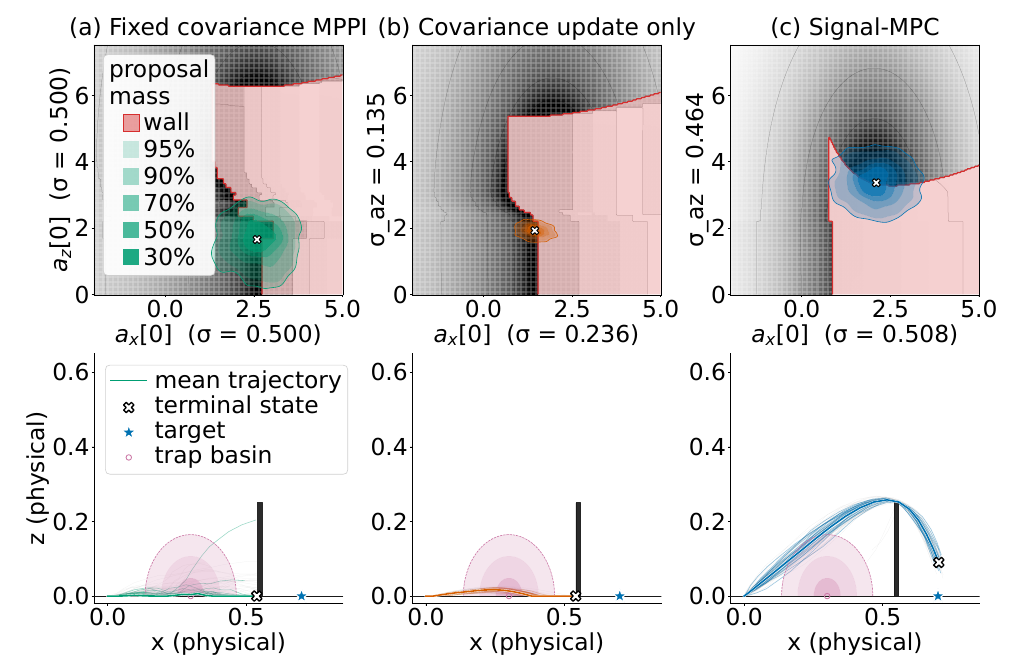
Reuse MPPI’s sample–rollout–reweight interface to extract a zeroth-order update for both μ and Σ.
A primal–dual update adjusts the entropy multiplier online, preserving a minimum sampling volume.
A stable structured update keeps Σ positive definite under noisy finite-sample estimates.
03 · Results
Across quadruped and humanoid control, adaptive covariance makes the search more sample efficient and preserves performance under tighter real-time compute budgets.
Signal-MPC improves over fixed-covariance MPPI and diffusion-style annealing by as much as twofold.
Compared with 0% for MPPI and 17% for DIAL-MPC under the same rollout budget.
Compared with 50% for MPPI and 33% for DIAL-MPC on the humanoid walk task.
From simulation to hardware
Signal-MPC runs on a Unitree Go2 using an onboard EKF, without motion capture or an offline-trained policy.
Success rates are reported in Table I of the current manuscript.
04 · Rollout gallery
Select a task to compare DIAL-MPC, Signal-MPC, and fixed-covariance MPPI under the same contact-rich objective.
Go2 · emergent gait discovery
With no gait prior, the controller must discover useful contact sequences online, then concentrate its sampling distribution around a repeatable pattern.
Curves visualize sampled rollout trajectories; the robot motion follows the optimized mean control sequence.
Paper release
The arXiv link and citation metadata will be added here when the paper is released.